
Understanding the science of energy balance, insulin signaling, appetite regulation, food processing, and why researchers are still investigating the complex causes of obesity.
Why do some people gain weight more easily than others?
Why can two individuals consume similar diets yet experience different changes in body composition?
Why does losing weight sometimes become progressively more difficult, even when someone maintains the same dietary habits?
And why have decades of research, countless dietary programs, and major advances in nutritional science still not produced a complete explanation for the global rise in obesity?
These questions reveal an important distinction in nutritional science:
Understanding how body weight changes is not necessarily the same as understanding why those changes occur.
The conventional explanation for weight gain is straightforward.
When energy intake chronically exceeds energy expenditure, the excess energy is stored within the body, primarily as fat.
This relationship is consistent with the physical laws of energy conservation.
However, it does not independently explain what caused someone to consume more energy, expend less energy, or alter the distribution of fuels among tissues.
Consider a common analogy: a bathtub fills when the amount of water entering exceeds the amount leaving. That observation accurately describes the change in water volume, but it does not identify whether the problem began with a faucet left running, a partially blocked drain, or another malfunction in the system.
Similarly, the accumulation of body fat can be described through energy balance without necessarily identifying the biological, psychological, behavioral, and environmental processes responsible.
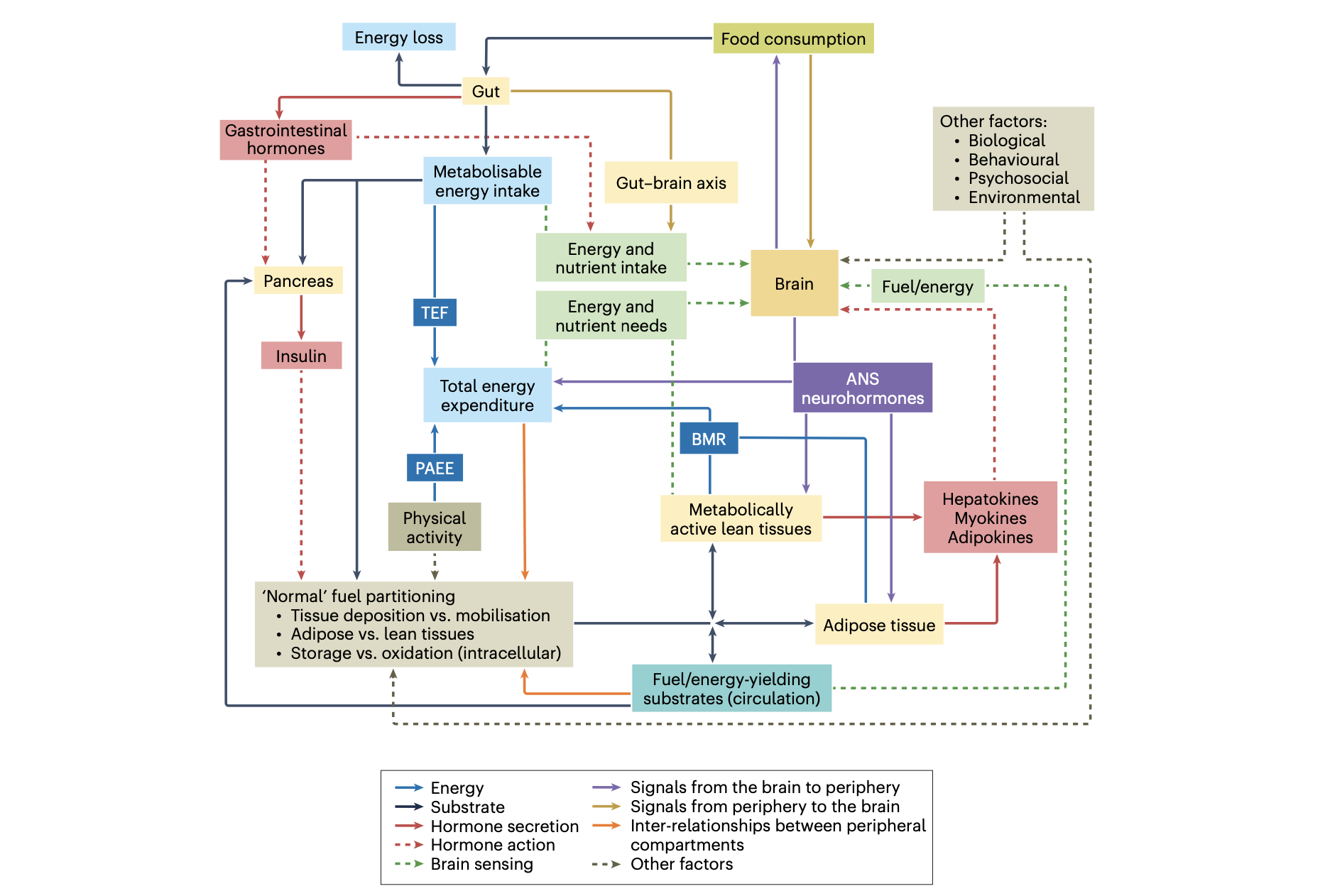
This distinction is central to a 2024 perspective published in Nature Metabolism, titled On the Pathogenesis of Obesity: Causal Models and Missing Pieces of the Puzzle.
The paper brought together an international group of obesity researchers representing several competing scientific perspectives.
Among the contributors were Kevin Hall, David Ludwig, Gary Taubes, Eric Ravussin, John Speakman, and other prominent investigators.
Rather than simply defending one theory, the researchers attempted to identify areas of agreement, clarify fundamental disagreements, and establish which experiments could help resolve them.
Their conclusion was important:
Despite decades of investigation, the causes of obesity remain extraordinarily complex, and several important scientific questions remain unanswered.
More recent research published in Nature Reviews Endocrinology, Nature Medicine, Nature Metabolism, and the International Journal of Obesity has continued to investigate these questions.
Together, these findings support a more comprehensive understanding of weight regulation.
Obesity is not simply the consequence of one nutrient, one hormone, one behavior, or one environmental exposure. It emerges through interactions among biological regulation, food availability, dietary composition, behavior, and individual susceptibility.
1. Energy Balance: A Fundamental Principle, but Not a Complete Explanation
Energy balance describes the relationship between energy entering the body and energy expended over a given period.
Energy intake comes primarily from food and beverages.
Energy expenditure includes several components.
Basal metabolism supports the physiological processes necessary for life.
Physical activity requires energy for movement.
The thermic effect of food reflects energy expended during nutrient digestion, absorption, and processing.
Thermoregulation and other physiological demands can also influence expenditure.
When metabolizable energy intake exceeds expenditure over a sustained period, body energy stores generally increase.
When expenditure exceeds intake, stored energy is mobilized.
These relationships are fundamental to human physiology.
However, the 2024 Nature Metabolism paper emphasizes that the laws of energy conservation do not specify which physiological processes caused the imbalance.
For example, increased appetite may precede increased food consumption.
A medication may alter hunger or energy expenditure.
Changes in sleep may influence appetite and daily activity.
Hormonal or metabolic changes may influence food intake, energy expenditure, or the handling of available fuels.
These mechanisms are not interchangeable.
The challenge is understanding which factors initiate and sustain weight gain in different individuals.
2. The Energy Balance Model: Why the Food Environment Matters
One influential explanation for obesity is the energy balance model, commonly abbreviated EBM.
The model emphasizes how characteristics of the modern food environment can promote energy intake beyond physiological requirements.
Its proponents highlight the widespread availability of foods that are inexpensive, convenient, energy-dense, highly palatable, and frequently offered in large portions.
These foods may be formulated with combinations of refined carbohydrates, fats, salt, and other ingredients that make them especially appealing.
Some are relatively low in fiber or protein compared with their energy content.
According to the EBM, these characteristics can influence appetite, reward processing, and food consumption.
When individuals repeatedly consume more energy than they expend, the excess energy is stored.
The model does not assume that all overeating is consciously intentional.
It recognizes that food intake is regulated through complex neural, hormonal, behavioral, and environmental processes.
For example, food availability and sensory cues may encourage eating even when immediate physiological energy requirements have been met.
The EBM therefore places considerable emphasis on the relationship between the food environment and the brain's regulation of eating behavior.
3. The Carbohydrate–Insulin Model: Could Fuel Storage Come First?
A second influential explanation is the carbohydrate–insulin model, or CIM.
Rather than treating excessive food consumption as the primary initiating event, this model emphasizes changes in how the body distributes and stores metabolic fuels.
Its proponents propose that diets rich in rapidly digestible carbohydrates may produce hormonal responses that favor fat storage under certain conditions.
The resulting changes in circulating fuel availability could then influence hunger and energy expenditure.
For example, a high-glycemic-load meal can produce a substantial increase in blood glucose and insulin signaling.
Insulin plays an important role in coordinating nutrient storage and suppressing fat release from adipose tissue.
These are normal physiological functions.
However, the CIM proposes that certain dietary patterns may promote excessive partitioning of energy toward storage, contributing to increased hunger or compensatory reductions in energy expenditure.
Under this framework, increased energy intake may arise partly as a consequence of altered fuel distribution.
This is a key distinction.
The EBM places excessive energy intake earlier in the proposed causal sequence.
The CIM places altered fuel partitioning earlier.
Both recognize that sustained body-fat accumulation must ultimately conform to energy conservation.
However, they disagree about which mechanisms are most responsible for initiating and sustaining that accumulation.
4. What Do the Two Models Actually Agree On?
Although often presented as competing explanations, the EBM and CIM share several important principles.
Both recognize that energy conservation governs changes in body energy stores.
Both acknowledge that hormones, the nervous system, and peripheral tissues influence metabolism.
Both recognize that food composition can alter physiological responses.
Both accept that behavioral, environmental, genetic, and developmental factors may contribute to obesity.
Their primary disagreement concerns the relative importance and causal ordering of particular processes.
This is why the 2024 Copenhagen workshop was scientifically valuable.
Rather than treating the debate as a contest between counting calories and regulating insulin, the participants attempted to identify testable predictions.
For example, researchers need to determine whether dietary composition influences long-term body-fat accumulation independently of energy intake.
They also need to establish whether experimentally altering circulating fuel availability changes hunger, energy expenditure, or subsequent weight gain.
These questions require carefully designed human studies.
The paper does not declare either model definitively established.
Instead, it identifies unresolved questions that future research must address.
5. Why Insulin Should Not Be Treated as the Enemy
Insulin is sometimes portrayed as a hormone whose primary purpose is to promote fat accumulation.
This characterization is incomplete.
Insulin is essential for normal metabolic regulation.
It participates in glucose uptake, glycogen synthesis, protein metabolism, and numerous other physiological processes.
Its secretion normally increases after meals, particularly following carbohydrate intake.
Protein can also stimulate insulin secretion.
The significance of insulin therefore depends on the physiological context.
An appropriate postprandial insulin response is not equivalent to pathological hyperinsulinemia or insulin resistance.
Similarly, lowering insulin does not automatically guarantee body-fat loss.
The 2024 paper recognizes insulin's important role in fuel partitioning while distinguishing established physiology from hypotheses about the causes of obesity.
For nutrition, this means that insulin responses should be understood as part of a coordinated metabolic system rather than treated as universally harmful.
6. The Brain: A Central Regulator of Energy Intake and Expenditure
The brain continuously receives information about the body's physiological condition.
Signals arise from the gastrointestinal tract, pancreas, adipose tissue, liver, and other organs.
These include hormones involved in appetite and metabolic regulation.
Examples include leptin, insulin, ghrelin, glucagon-like peptide-1, peptide YY, and glucose-dependent insulinotropic polypeptide.
The brain integrates these signals with sensory information, learned experiences, environmental cues, and other influences.
This information helps regulate hunger, satiation, food seeking, and aspects of energy expenditure.
A 2025 Nature Reviews Endocrinology article, Advances in Appetite Regulation by the Arcuate Nucleus, describes new findings involving hypothalamic pathways that respond to metabolic and sensory signals.
The review highlights how neural circuits involved in appetite regulation can adapt according to nutritional conditions.
These findings reinforce that eating behavior is not governed exclusively by conscious decision-making.
Physiological systems influence the motivation to obtain food and the experience of fullness.
However, these systems do not eliminate personal agency.
They help explain why dietary behavior may become more challenging under certain biological or environmental conditions.
7. Leptin and the Biology of Energy Stores
Leptin is produced primarily by adipose tissue.
Its circulating concentrations generally reflect the amount of stored body fat, although the relationship is influenced by other factors.
Leptin communicates information about energy availability to the nervous system.
When body-fat stores decline, leptin concentrations often decrease.
This can contribute to physiological responses that favor energy conservation and increased food seeking.
In rare congenital leptin-deficiency conditions, leptin replacement can produce profound improvements in appetite regulation and body weight.
However, most common obesity is not caused by a simple leptin deficiency.
Many individuals with obesity have elevated circulating leptin concentrations.
Researchers are investigating why the brain may respond differently to leptin signaling in these circumstances.
These findings illustrate an important principle.
The amount of a hormone present does not always reveal how effectively its signal is being interpreted.
The relevant biological response depends on receptors, neural circuits, physiological context, and feedback regulation.
8. Is Body Weight Regulated Around a Set Point?
Another major question concerns whether the body actively defends a particular weight or level of adiposity.
A 2025 review published in Nature Reviews Endocrinology, Body Weight Regulation Models in Humans: Insights for Testing Their Validity, examines several competing frameworks.
One is the set point model.
This model proposes that physiological mechanisms defend body weight or adiposity around a regulated value.
When weight falls below the defended range, compensatory responses may emerge.
These can include increased hunger and reduced energy expenditure.
Another framework is the dual-intervention point model.
Rather than proposing one precisely defended body weight, this model suggests that the body may tolerate a relatively broad range of weights.
Stronger regulatory responses may emerge near the boundaries of that range.
The two models make different predictions concerning responses to changes in energy balance.
However, neither has been conclusively established as a universal explanation for human body-weight regulation.
The researchers emphasize the need for rigorous experiments capable of distinguishing their predictions.
For patient education, the important point is that body-weight regulation may involve biological feedback mechanisms that influence responses to dietary change.
9. Why Weight Loss Can Become More Difficult Over Time
Weight-loss interventions often produce changes in appetite and energy expenditure.
As body mass decreases, the energy required to maintain and move the body generally declines.
In some circumstances, energy expenditure may also decrease beyond what would be predicted from changes in body composition alone.
This is commonly described as adaptive thermogenesis.
Appetite-related signals may change as well.
These compensatory responses can make continued weight loss or weight maintenance more challenging.
However, their magnitude varies among individuals.
Not everyone experiences the same degree of hunger or metabolic adaptation.
The practical implication is that a dietary strategy effective during the initial stages of weight reduction may require adjustment later.
Long-term support may be necessary.
This is one reason short-term diet success should not automatically be interpreted as evidence of long-term sustainability.
10. Ultra-Processed Foods: What Does Experimental Research Show?
Food processing has become an important focus of obesity research.
Ultra-processed foods are generally characterized by extensive industrial formulations that may include ingredients, additives, and processing methods uncommon in domestic food preparation.
However, the category includes diverse products with different nutritional characteristics.
A landmark 2019 randomized inpatient study published in Cell Metabolism examined how ultra-processed and minimally processed diets influenced food intake.
Twenty adults consumed each diet for approximately two weeks.
The researchers attempted to match the provided diets for several nutritional characteristics.
Participants were allowed to eat as much or as little as they wanted.
During the ultra-processed diet, participants consumed approximately 500 additional calories per day.
They also gained weight, while they lost weight during the minimally processed diet.
This was an important experimental demonstration that dietary characteristics can influence energy consumption even when participants are not instructed to restrict calories.
However, the trial was small and relatively short.
It also did not isolate one individual processing characteristic responsible for the observed effects.
Nevertheless, the study provides evidence that food characteristics can influence eating behavior and energy balance.
11. What Newer Research Says About Food Processing and Weight Regulation
A 2025 randomized crossover trial published in Nature Medicine compared minimally processed and ultra-processed diets that both followed national healthy-eating guidance.
Participants consumed each dietary pattern over an eight-week period.
Both diets were associated with weight reduction.
However, the minimally processed diet produced a greater average reduction in body weight.
The difference between diets was approximately one percentage point of baseline body weight over eight weeks.
Researchers also observed differences in selected body-composition measures and dietary cravings.
However, the study had several limitations.
The sample was relatively small, and not every participant completed both interventions.
The authors also acknowledged uncertainty about the mechanisms responsible.
Subsequent scientific correspondence raised additional questions about interpreting dietary crossover experiments.
These discussions reinforce why food-processing research remains an active scientific field.
Nevertheless, the trial provides evidence that dietary characteristics beyond conventional macronutrient targets may influence outcomes.
12. Why Protein and Fiber Matter
Protein and fiber can influence food intake through several mechanisms.
Protein contributes to satiety, tissue maintenance, and the thermic effect of food.
Dietary fiber can influence gastrointestinal function, food texture, energy density, and microbial fermentation.
The 2024 Nature Metabolism paper discusses the possibility that the modern food environment promotes excessive intake partly through foods that are energy-dense but comparatively low in protein and fiber.
This relates to the protein leverage hypothesis.
The hypothesis proposes that humans may regulate protein intake with sufficient priority that diets relatively low in protein can encourage greater overall food consumption.
A 2025 study in Nature Metabolism, Short-Term Effects of High-Protein, Lower-Carbohydrate Ultra-Processed Foods on Human Energy Balance, examined how protein enrichment influenced short-term intake and expenditure.
In a controlled crossover study involving 21 young adults, the higher-protein ultra-processed diet produced lower energy intake and greater energy expenditure compared with the comparison diet.
However, the intervention did not eliminate overeating.
This finding illustrates why improving one nutritional characteristic may be helpful without fully addressing every influence on food intake.
Dietary quality involves more than one macronutrient.
13. Energy Density, Palatability, and Eating Behavior
Energy density describes the amount of metabolizable energy contained in a given weight of food.
Foods with high energy density provide relatively more calories per gram.
Food palatability describes how pleasant a food is to consume.
These characteristics can influence eating behavior.
However, highly palatable foods are not inherently unhealthy.
Nor does energy density alone determine nutritional quality.
Nuts, olive oil, and other nutrient-rich foods can be relatively energy-dense.
Conversely, some low-energy-density foods may provide limited nutritional value.
The important question is how food characteristics influence total dietary patterns, nutrient adequacy, appetite, and long-term energy balance.
Researchers are increasingly examining how texture, eating rate, protein content, fiber, and combinations of nutrients contribute to these outcomes.
This approach moves beyond treating foods as collections of calories alone.
14. How the Gut Microbiome Complicates Calorie Counting
The amount of energy listed on a food label does not necessarily correspond perfectly to the amount metabolized by every individual.
Different foods vary in digestibility and the energy lost through fecal excretion.
The gastrointestinal microbiome can also metabolize substances that human digestive enzymes do not fully break down.
For example, microbial fermentation of certain dietary fibers produces short-chain fatty acids.
Some of these compounds can be absorbed and used by the body.
The 2024 paper emphasizes that metabolizable energy can differ according to dietary composition and microbial activity.
However, these differences do not invalidate energy conservation.
They demonstrate that accurately estimating the energy entering the body's usable metabolic pool is more complicated than reading a number on a package.
The practical implication is that calorie estimates are useful but imperfect.
They should not be treated as precise measurements of the actual energy absorbed by every individual.
15. The Role of Sleep, Stress, and Circadian Regulation
The causes of weight gain are not limited to dietary composition.
Sleep and circadian regulation can influence appetite, behavior, and metabolic processes.
Insufficient sleep may change hunger-related responses, food preferences, and the capacity to maintain established routines.
Psychological stress can also influence eating behavior.
Some individuals eat more during periods of stress.
Others experience reduced appetite.
Occupational schedules, shift work, caregiving responsibilities, and social circumstances may affect when and how food is consumed.
The 2024 Nature Metabolism paper explicitly recognizes these behavioral and psychosocial influences as potential contributors to obesity.
However, stress does not explain every case of weight gain.
Nor does improving sleep automatically produce weight loss.
These factors are relevant because body-weight regulation takes place within the context of everyday life.
16. Environmental Factors Beyond Food
An important strength of the 2024 paper is its recognition that obesity may involve environmental influences beyond food availability.
The authors discuss several possibilities, including built environments, social circumstances, developmental conditions, medications, and environmental exposures.
A 2024 review in the International Journal of Obesity, Obesogens: A Unifying Theory for the Global Rise in Obesity, examines the hypothesis that certain environmental chemicals may contribute to metabolic dysfunction and weight gain.
The authors discuss mechanisms through which some exposures could influence endocrine signaling, adipocyte development, or other metabolic processes.
However, the obesogen hypothesis remains an active research area.
Evidence differs substantially across chemical exposures, study designs, and populations.
It would be inappropriate to attribute an individual's obesity to environmental toxins without specific evidence.
Nevertheless, the research broadens scientific investigation beyond diet and exercise alone.
17. Genetics: Why Individuals Respond Differently to the Same Environment
Genetic variation contributes to differences in body composition, appetite regulation, and susceptibility to obesity.
Some rare genetic conditions can produce profound disturbances in appetite and energy regulation.
More commonly, susceptibility involves many genetic variants, each contributing relatively small effects.
These genetic influences interact with the environment.
Two individuals may encounter similar food availability but respond differently in appetite, intake, or weight trajectories.
A 2025 Nature Reviews Endocrinology review emphasizes that obesity develops through interactions between an obesogenic environment and individual biological susceptibility.
This distinction is important.
Genetic susceptibility does not mean that weight outcomes are predetermined.
It means that different individuals may face different biological challenges under similar environmental conditions.
Consequently, identical dietary recommendations may not be equally effective or sustainable for everyone.
18. Why Obesity Is Not Simply a Failure of Willpower
The scientific evidence demonstrates that weight regulation involves processes operating beyond conscious intention.
Hormones influence appetite.
Neural circuits respond to food cues.
Medications may affect weight.
Sleep and stress can change eating behavior.
Environmental conditions influence access to nutritious foods.
Genetic and developmental factors contribute to individual susceptibility.
None of these mechanisms eliminates the importance of behavior.
However, they challenge the assumption that everyone faces identical conditions when attempting to manage body weight.
An individual may understand nutritional recommendations yet experience substantial difficulty implementing them because of appetite, occupational demands, financial constraints, physical limitations, or other circumstances.
Effective care therefore requires understanding barriers rather than simply repeating generic instructions.
19. Why Weight Loss and Obesity Prevention Are Different Scientific Questions
One particularly important argument in the uploaded paper concerns the distinction between preventing obesity and treating established obesity.
Identifying a factor that contributes to disease development does not necessarily mean removing that factor will fully reverse the disease.
For example, long-term weight gain may produce adaptations in appetite regulation, energy expenditure, tissue function, and other physiological processes.
These adaptations can influence subsequent responses to treatment.
Consequently, a dietary factor that contributes to weight gain may not be the only factor maintaining obesity once it is established.
The authors emphasize that understanding disease causation and identifying effective treatment strategies are related but distinct scientific objectives.
This helps explain why long-term treatment may require more than simply reversing the presumed initial cause.
20. What Does This Mean for Low-Carbohydrate and Low-Fat Diets?
The debate between the EBM and CIM is sometimes translated into a competition between low-carbohydrate and low-fat diets.
However, neither dietary category is uniform.
A low-carbohydrate diet may emphasize nutrient-rich foods or rely heavily on highly processed products.
A low-fat diet may emphasize vegetables, fruits, legumes, and whole grains or contain substantial amounts of refined carbohydrates.
The physiological and clinical effects can therefore differ considerably.
Research suggests that both approaches can produce weight loss under appropriate conditions.
Their relative effectiveness varies with dietary adherence, energy intake, food quality, individual characteristics, and other factors.
The 2024 Nature Metabolism perspective does not establish that one approach is universally superior.
Instead, it argues for better experiments capable of identifying which dietary mechanisms drive weight regulation.
For clinical nutrition, the objective should be to identify strategies that support metabolic health, nutrient adequacy, and sustainable behavior.
21. Why Body Composition Matters More Than Weight Alone
Body weight does not distinguish among fat mass, skeletal muscle, bone, water, and other components.
Consequently, two individuals with identical body weights can have substantially different physical and metabolic characteristics.
Changes in weight can also reflect different tissues.
For example, weight loss may involve reductions in fat mass, lean mass, glycogen, or body water.
The relative contributions depend on numerous factors.
These include dietary intake, physical activity, resistance training, age, and medical conditions.
A comprehensive approach should therefore consider outcomes beyond total body weight.
Depending on the individual's needs, these may include waist circumference, body composition, strength, fitness, blood pressure, glucose regulation, and lipid measurements.
These outcomes can provide a more informative picture of health than weight alone.
22. Precision Nutrition: Understanding Which Mechanisms Matter for Each Individual
The emerging science of precision nutrition seeks to identify why individuals respond differently to dietary interventions.
Relevant variables may include habitual dietary patterns, metabolic health, physical activity, medications, sleep, age, and individual preferences.
However, precision nutrition is not simply the use of more sophisticated laboratory testing.
The purpose of additional information is to improve decisions.
For example, identifying a nutrient deficiency can guide appropriate dietary correction.
Recognizing inadequate protein intake may inform strategies supporting satiety or muscle maintenance.
Identifying insulin resistance may influence the management of cardiometabolic risk.
Understanding significant gastrointestinal symptoms may require modifying certain food choices or pursuing appropriate medical evaluation.
By contrast, an exploratory genetic or microbiome finding may not provide a validated basis for selecting a weight-management diet.
A scientifically responsible approach prioritizes measurements that inform meaningful interventions.
23. Why Better Nutrition Research Is Still Needed
The authors of the 2024 paper conclude that many fundamental questions remain unresolved.
Human nutrition research is difficult.
Long-term dietary studies can be expensive and challenging to control.
Participants may not adhere consistently to prescribed interventions.
Methods for estimating food intake contain measurement error.
Differences in weight regulation may emerge gradually over years.
Short-term metabolic responses may not accurately predict long-term outcomes.
The authors recommend stronger controlled-feeding studies, longer free-living dietary interventions, and longitudinal research capable of tracking metabolic changes before and during weight gain.
They also encourage cooperation among researchers with opposing hypotheses.
This is particularly important because scientific disagreement should generate better experiments rather than increasingly rigid ideological positions.
The purpose of a scientific model is not to defend it indefinitely. It is to produce predictions that can be tested, refined, or rejected.
24. How This Research Informs Eat Well at Arete Health
We recognize that body-weight regulation and metabolic health involve more than dietary arithmetic.
Energy intake and expenditure remain important.
However, nutritional decisions occur within a complex biological and environmental system.
Appetite, food quality, metabolic health, physical activity, sleep, stress, and individual circumstances can influence eating behavior and long-term outcomes.
Our Eat Well philosophy emphasizes personalized nutrition education and practical strategies that support metabolic health.
Depending on the individual's needs, this may involve evaluating dietary quality, macronutrient balance, micronutrient adequacy, fiber intake, meal patterns, and relevant lifestyle behaviors.
We also recognize the importance of understanding the individual's goals.
For some people, weight management may be a relevant clinical objective.
For others, improving metabolic markers, nutritional adequacy, exercise performance, or general well-being may be more appropriate.
Our approach does not assume that one dietary model is universally correct.
Nor do we suggest that calorie counting, carbohydrate restriction, fasting, or any other nutritional strategy is appropriate for everyone.
Instead, the goal is to understand which factors can be modified safely and sustainably, monitor meaningful outcomes, and adjust recommendations according to individual responses.
When patients have obesity-related complications or medical conditions requiring specialized treatment, collaboration with appropriately qualified healthcare professionals remains important.
Conclusion: The Future of Weight Management Requires Better Questions
The science of obesity has advanced substantially over the past several decades.
Researchers now understand far more about appetite-related hormones, neural regulation, energy metabolism, adipose tissue biology, and environmental influences.
However, important questions remain unanswered.
The energy balance model emphasizes how the modern food environment may promote excessive intake.
The carbohydrate–insulin model emphasizes how dietary composition and hormonal responses may alter fuel partitioning and influence subsequent hunger or expenditure.
Both operate within the physical laws governing energy conservation.
Their disagreement concerns the causal pathways leading to excess body-fat accumulation.
More recent research continues to demonstrate that food processing, appetite regulation, biological susceptibility, and environmental circumstances can contribute to weight outcomes.
Yet the relative importance of these mechanisms varies, and additional research is needed.
For practical nutrition, the most important lesson is not that one dietary theory has finally defeated another.
It is that successful healthcare requires understanding the individual and the conditions shaping their biological and behavioral responses.
Calories describe the energy available within a dietary pattern. But understanding health requires asking how that food influences appetite, metabolism, behavior, nutrient adequacy, and the individual's capacity to maintain meaningful changes over time.
We believe this perspective supports a more comprehensive approach to personalized nutrition.
Rather than reducing metabolic health to a single equation or promoting one universal diet, we aim to help individuals understand the interacting factors that influence their health and develop strategies that are appropriate, sustainable, and informed by scientific evidence.
Research References
Magkos F, Sørensen TIA, Raubenheimer D, et al. On the pathogenesis of obesity: causal models and missing pieces of the puzzle. Nature Metabolism. 2024;6:1856–1865. https://doi.org/10.1038/s42255-024-01106-8
Fernández-Verdejo R, Ravussin E, Galgani JE. Body weight regulation models in humans: insights for testing their validity. Nature Reviews Endocrinology. 2025;21:703–717. https://doi.org/10.1038/s41574-025-01149-1
Garcia-Caceres C. Advances in appetite regulation by the arcuate nucleus. Nature Reviews Endocrinology. 2025;21:71–72. https://doi.org/10.1038/s41574-024-01079-4
Heindel JJ, Lustig RH, Howard S, Corkey BE. Obesogens: a unifying theory for the global rise in obesity. International Journal of Obesity. 2024;48:449–460. https://doi.org/10.1038/s41366-024-01460-3
Hesketh KD, Zheng M, Campbell KJ. Early life factors that affect obesity and the need for complex solutions. Nature Reviews Endocrinology. 2025;21:31–44. https://doi.org/10.1038/s41574-024-01035-2
Dicken SJ, Jassil FC, Brown A, et al. Ultraprocessed or minimally processed diets following healthy dietary guidelines on weight and cardiometabolic health: a randomized, crossover trial. Nature Medicine. 2025;31:3297–3308. https://doi.org/10.1038/s41591-025-03842-0
Bosy-Westphal A, et al. Short-term effects of high-protein, lower-carbohydrate ultra-processed foods on human energy balance. Nature Metabolism. 2025;7:704–713. https://doi.org/10.1038/s42255-025-01247-4
Ludwig DS, Willett WC, Putt ME. Concern for the validity of short-term dietary crossover trials. Nature Medicine. 2025;31:2913–2914. https://doi.org/10.1038/s41591-025-03909-y
Hall KD. Reply to: Concern for the validity of short-term dietary crossover trials. Nature Medicine. 2025;31:2915–2916. https://doi.org/10.1038/s41591-025-03911-4
Hall KD, Ayuketah A, Brychta R, et al. Ultra-processed diets cause excess calorie intake and weight gain: an inpatient randomized controlled trial of ad libitum food intake. Cell Metabolism. 2019;30:67–77.e3. https://doi.org/10.1016/j.cmet.2019.05.008
Prakash SS. Energy-balance and carbohydrate-insulin models of obesity are not competing propositions. International Journal of Obesity. 2023;47:95–97. https://doi.org/10.1038/s41366-022-01249-2